
When Megan Rutherford Murray first heard about The Garden, she was in the middle of cold-stratifying a batch of milkweed seeds in her refrigerator. Having been introduced to the show through a mutual friend, and as an avid gardener herself, she decided to apply for the position.
"I found out it was time to take them out right when I got the job," she said. "It all works out the way it needs to."
Megan brings over a decade of New York theater experience to the production. Originally from outside Houston, she studied at UNC Chapel Hill before coming to New York for grad school at NYU, and she's been a freelance theater artist in the city for the eleven years since. She's designed for site-specific and outdoor productions before, and she's worked with student performers, though mostly at the high school level. The Garden marks her first time designing for theater made specifically for very young audiences.
With an audience of mostly under 5, she’s thinking all about interaction.
"It's the part about little hands and the grabbiness and that level of interaction which is an exciting new challenge," she said. "How do we capture attention? How do we make sure that these things feel interesting, and maybe a little strange to look at, something that really makes you want to just lean in and be closer to it."
Her garden designs aim to lean into texture and movement: metallics that catch the light, pieces that hang and dangle, elements built to draw a young child in and hold their focus; all while being able to survive a wash cycle and come back ready for the next performance.
Workwear as a Starting Point
The costumes begin as thrifted workwear. The Garden has an interesting set of costuming challenges, and Megan wanted the base garments to carry the practicality of outdoor labor, hardwearing fabric that can take a beating.
"We're going with this idea of work wear that has been transformed by the keeping of these elements within the show," she explained, "I’ve been thinking about the hardwearing nature of gardening or outdoor labor, and things that feel extremely practical, but then transformed."
Sustainability runs through her material choices, sourcing secondhand as much as possible, from thrift stores to online resale to salvage spots like Materials for the Arts.
"I'm really hoping to find everything I can secondhand to start with, and then build out from there".
Sustainability has a secondary perk as well, as worn-in fabric already has a kind of movement and life that something fresh off a factory shelf doesn't.
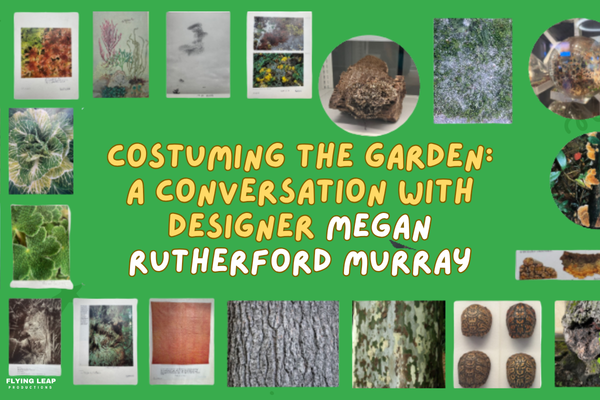
Because The Garden is so specifically a New York story, Megan wanted the design references to feel local to the environment. She pointed to the London plane tree, the most common tree in New York City, known for its mottled, colorful bark, and to the schist rock formations visible in Central Park, right beneath New Yorkers' feet. The goal, she said, was to keep the design recognizable and grounded rather than pulling from a version of "nature" that felt distant from the city.
Designing With, Not Just For, the Performers
Sometimes when designing for a unique environment, the performers themselves have insights that you may never have considered. Keeping open dialogue is important, and an ongoing back-and-forth with Megan and the performers, several of whom have been part of The Garden since earlier stages of its development, began early in the process.
"I really like to keep an open line of communication with all of my performers," she said. "It's so important that the costume is not restrictive, that it only helps them in their performance."
She uses these dialogues as opportunities to listen: what concerns performers have (mud came up early), what they've seen work in past performances, what makes them feel comfortable in a garment.
Workwear spans a wide range, from fitted to overalls to coveralls, and from typically masculine to typically feminine silhouettes, so she's given performers a chance to react to different options and find what feels like their own before any modifications begin.
Where Things Stand
The team is roughly two months into the design process. Early research included time at the American Museum of Natural History and its picture collection archive, along with long walks near Megan's home, which sit close to water and green space that have informed her thinking about the show's natural world. She's now deep in the thrifting phase, sourcing base garments with fittings hopefully starting soon.
One ongoing challenge is designing for New York's unpredictable fall weather. An October performance could hit 90 degrees or 30, so the costumes need to hold up across a wide range of conditions while keeping performers safe and comfortable. Once fittings are complete, the next phase moves into detailed embellishment: paint, fabric manipulation, and testing how different materials, including natural dyes, hold up after repeated washing.
As Megan put it, the process is still in that in-between stage of moving from ideas into physical reality.
"Check back in two weeks," she said. "There will be a huge difference."