
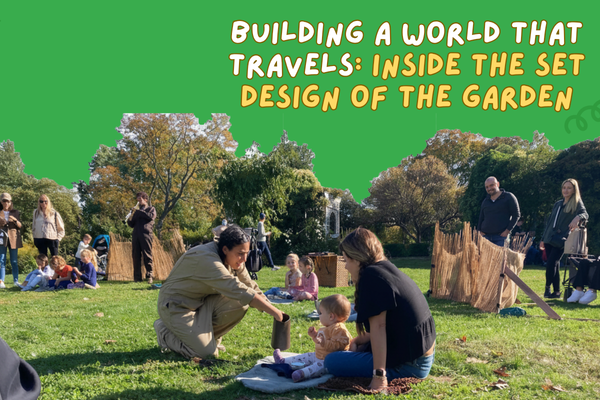
Most set design begins with a pre-defined theatrical space. There are walls, a floor plan, and a fixed relationship between the audience and the thing they came to see. These pre-defined spaces provide clear parameters for what can and can’t be done within a design.
The Garden has no pre-defined theatrical space.
Flying Leap's outdoor performance for children aged 0–5 unfolds on the grass in public parks, NYCHA courtyards, the green spaces of botanic gardens, and settlement houses across all five boroughs. The design team at Queens Lighting Collective began working on The Garden with a question: what does a world look like when it has to be highly portable, survive the outdoors of New York, and feel like it belongs in ten different neighborhoods at once?
No Fixed Setting, No Fixed Solution
Because The Garden tours, the design has to hold across wildly different conditions. A performance might sit in dappled shade under mature trees one weekend and full midday sun on an open lawn the next. The ground could be soft grass, packed dirt, or the paved edge of a courtyard. The ambient soundtrack could be birdsong or the Bruckner Expressway.
The collective's response was not to build ten different versions of the show. It was to build one design flexible enough that each site completes it differently.
That means the environment of a particular show isn't challenged, it's embraced. Natural light is the lighting design. The sky is the ceiling. The existing trees, slope of the lawn, and surrounding flora all become part of the visual language rather than obstacles to disguise. Every location the show has played has quietly shaped what the design needed to be, and the result is a world that reads as native to whichever park it lands in.
It also means the design must work with limitations most theater never faces: no grid to rely on, no power access, no trace left behind. Public park permitting standards are a core part of the brief, and the reason the show can travel anywhere families already are.
Materials, Texture, and the Sensory Experience
The material instincts here run parallel to costume designer Megan Rutherford Murray's work: weathered over new, tactile over slick, secondhand wherever possible. Worn material already carries movement and history that fresh-off-the-shelf stock doesn't, and it sits more honestly next to real bark, real seed, real dirt.
The palette stays grounded in the city's actual nature rather than a generic idea of the outdoors, the idea being that these are textures a child will encounter on the walk home.
Running underneath the naturalism is a deliberate note of sensory experience. Objects that catch light unexpectedly. Elements that hang and shift in the wind. Something a child hasn't seen, and keeping it close enough to reach for.
What Families Carry Home
Before any text is spoken, the space has to communicate that this is somewhere you are allowed to be. Nothing is roped off. Nothing is out of reach. The audience sits on the same ground the performers move across, and the boundary between watching and participating is deliberately soft. That's the design's real function, and it's the same thing the production is built to do at every scale: remove the barrier.
The hope isn't that a family remembers a particular object. It's that they walk out of the park holding something more portable, the sense that this green space, and the arts more broadly, belong to them. That a public lawn ten minutes from home can be a place where something extraordinary happens, and that they were welcome there without having to earn it.
The set travels light on purpose. What it leaves behind is meant to stay.