
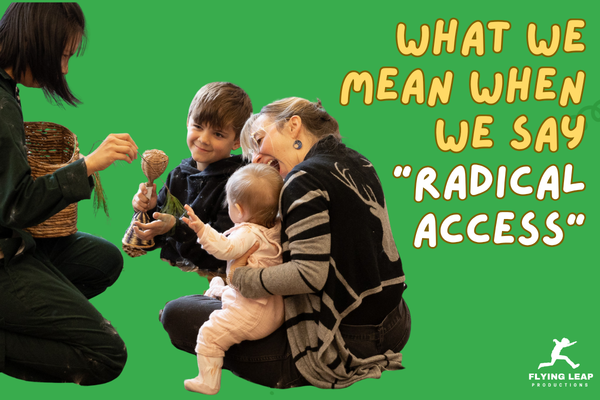
Access is a word that gets used a lot in the arts. Sometimes it refers to disability accommodations. Sometimes it means free tickets or sliding-scale pricing. These things matter, but when Flying Leap talks about radical access, we mean something bigger.
The concept emerged during development of The Garden, and is the brainchild of Director and Community Engagement Director Susanna Brock. It's one of the things that most distinctly shapes how we work. At its core, radical access is about asking the broadest possible question: what is actually getting in the way of a family experiencing this show, and what can we do about it?
A Wider Frame
Most conversations about access start with disability and economics. Those are essential starting points. But radical access adds geography, language, migration status, and something called cultural capital to the equation.
Cultural capital is the idea that not everyone feels they belong in a given space. In the world of performance, this extends to the feeling that art or theater is “for me” or “not for me”. Someone might be able to afford a Broadway ticket in theory, but if they've never been to a Broadway theater, don't know how to dress for it, aren't sure how to behave, and have spent their whole life receiving signals that that world isn't for them, the ticket price is only one of many barriers.
For families in many of the communities we serve, the barriers can be numerous and overlapping. Maybe they live in Parkchester and the idea of navigating 90 minutes of subway with a stroller to get to Midtown is simply not realistic. Maybe they're a multilingual family and most family theater assumes English fluency. Maybe their immigration status makes navigating unfamiliar institutional spaces feel risky rather than joyful.
Radical access means holding all of these barriers in view at the same time, not as a checklist, but as a lens that shapes every decision we make.
Built In, Not Added On
In the American theater, access is often an afterthought. Two sign-language interpreted performances. A scholarship program for school groups. A community outreach initiative that runs parallel to the main production.
We try to do the opposite. Radical access isn't something we add on at the end of our process; it's something we build into the beginning.
That shows up first in how we assemble a devising company. When we're pulling together the artists who will make a show, we ask: who has the lived experience of the communities we're hoping to reach? What perspectives do we need in the room to make good decisions about barriers we might not personally face?
It shows up in our producing model, too. We work in partnership with organizations that are based in and trusted by the communities we're bringing theater to. Those partners don't just help us find spaces. They help us ask better questions: What time works for families in this neighborhood? What languages do people here speak? What does this community actually need from an experience like this?
When you're working with a community-based organization rather than just an arts organization, the lines of inquiry naturally open up. Physical accessibility is one piece of a much larger conversation.
The Curb Cut Effect
One common example in disability rights discussions: curb cuts. Curb cuts, the places where a sidewalk slopes down to meet the street, were designed for wheelchair users. But they benefit everyone: people with strollers, people with injuries, people carrying heavy things, people who just had knee surgery. Designing for the people most excluded from a space tends to make that space better for everyone.
The same logic applies to how we at Flying Leap think about access. When we bring The Garden to a NYCHA community, choosing a site that families can walk to, creating an experience that doesn't require English fluency, making it free so cost is never the deciding factor, we're not just removing barriers for one group. We're building something that more families can say yes to.
And when a family sees a piece of theater for the first time in their own neighborhood, something shifts. The show becomes the beginning of a new relationship with what theater is, who it's for, and whether it's for them. That sense of belonging, once established, has a way of growing.
That's what we mean by radical access. Not a policy. Not a program. A way of working, from the first conversation in the room to the last performance in the park.