Recap from the 2026 TYA/USA Conference
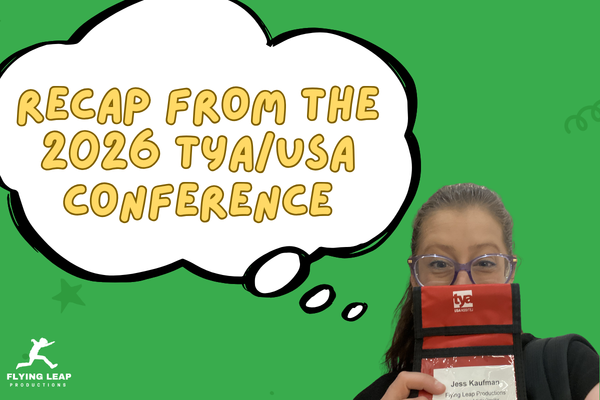
Every year, the TYA/USA Conference is a chance to step outside the day-to-day work of making theater and look at the bigger picture: what's happening across the field, what's shifting, and where our work fits inside all of it. This year, the conference was hosted by the Alliance Theatre in Atlanta, and it was one of the most energizing and clarifying we've attended. Logan joined for the first time, making it the first conference we've attended as a full team!
Here's what we took home.
A Growing Focus on Theater for the Very Young
This year had a notable concentration of programming centered on theater for the very young, or TVY: performances, breakout sessions, and new institutional investment all pointed in the same direction. Part of what made it feel special was the Alliance's Toddler Takeover, a multi-day festival of TVY programming that ran alongside the conference. The Philharmonic set up meet-a-musician sessions for families, TVY shows filled the Alliance's stages and the adjacent museum campus, and the energy was unlike anything we'd seen at a TYA gathering before.
Adding to that, the Alliance and TYA/USA jointly launched a new TVY development fellowship this year, a grant and support program that selected one TVY project from 45 national submissions to develop and present at the festival. Jess served on the grant panel, which meant she got the rare experience of reading a project's proposal and then seeing what it became in performance, with real kids in the room. That full arc, from idea to stage, was exciting to witness.
And it's worth naming what it felt like to be in a space where so much of the work shared our values. For artists who have sometimes felt like outliers in the field, it was genuinely affirming.
Negotiating Risk, and Rethinking Our Pre-Show Speech
One of the breakout sessions Jess attended was led by artist and choreographer Amanda Pintore, whose work centers on dance-based theater made with and for very young children. Amanda's session focused on how we navigate risk in TVY performance: how do we actually give adults permission to step back and let their kids experience a show the way the kid wants to experience it?
Amanda's company uses the phrase "If it's okay with you, it's okay with us" as an invitation at the top of their shows. But as she pointed out, saying it once isn't enough. Permission has to be earned, felt, and held throughout the experience.
That conversation sent Jess straight back to thinking about The Garden, and specifically our pre-show speech. How much of what we say is genuinely opening up space, and how much of it is actually narrowing it? It's a question we're sitting with as we build toward the fall tour.
Amanda also took home an award this year for her production Red, and we were so happy to see her honored.
The Intersection of Theater and Community Health
Another breakout session that stuck with us explored partnerships between arts organizations and health organizations, using the Orlando Family Stage as a case study. The panel laid out something we found both practical and exciting: a theater company and a health organization can serve overlapping communities in complementary ways, and when they work together, each one extends the reach and trust of the other.
The theater's community connects people to cultural programming and arts experiences. The health organization's community connects people to healthcare access and wellness resources. There isn't always overlap between those pools, which is exactly the point. Working together creates access that neither could generate alone.
The session also touched on performing arts medicine, a field that, remarkably, doesn't really exist yet in any formal way. The Orlando partnership began developing a team of specialists who treat performers the way sports medicine doctors treat athletes, attending to vocal health, physical health, and nutritional needs specific to the demands of performance work.
For us, this opened up real questions about The Garden and what community health partnerships might look like alongside our NYCHA programming. The work we're already doing connects families to community spaces and shared experiences. How might we be more intentional about the health and wellness dimensions of that work? We're curious to find out.
What's Happening in the Field
A few broader themes stood out from the week as a whole.
Eco-theater and environmental sustainability are having a moment. The TVY fellowship piece worked with recycled and upcycled materials. And the centerpiece of the weekend was getting to see the final dress rehearsal of Basura, a new musical by Gloria Estefan and her daughter, created in collaboration with TVY playwright Debra Wicks LaPuma. Basura tells the story of the Paraguayan trash orchestra, a real ensemble of children who built instruments from landfill scraps and created something extraordinary. There's a documentary, Landfill Harmonic, if you want to go deeper. The keynote conversation with Gloria Estefan and her daughter to close the conference was warm, honest, and worth every minute.
The other thread running through lunches and coffee conversations all week was sustainability in a different sense: what makes new work financially and structurally sustainable over time, without narrowing what the work can be? Not every show is designed to pack into a trunk and tour to any elementary school in the country, and that's okay. The field is working through what long-term viability can look like for work that resists easy scaling.
We came home with full notebooks, new connections, and a lot to think about. TYA/USA is always an incredible experience, but this year had such a substantial impact we will be thinking about it for months to come. We’re excited to see how what we learned over these last impactful few days changes our approach to the work!