
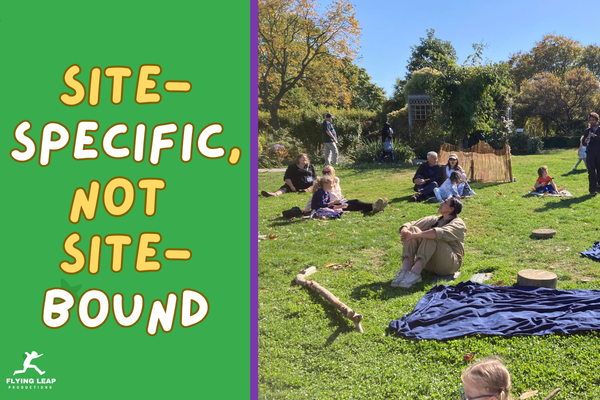
How did Flying Leap become the site-specific production company we are today?
If you think one day we sat down and decided to become a site-specific theater company, that’s not what happened. We started by making work, and then looked back at what we'd made. It took our collaborators Logan Schulman and Susanna Brock pointing out a pattern at one of our earliest company retreats, while we were workshopping our mission statement, for us to connect the dots..
Nearly everything in our founder's body of work had been made for real, specific places, with one exception: an indoor playground built to tour black box theaters, which in hindsight probably should have just been staged on an actual playground.
Site-specific was built into our DNA, but we had to run with it first to realize.
What "site-specific" means for us
There's an important distinction we make between site-specific and site-responsive work. A lot of site-specific theater is built around one exact location and its history: a particular pier, a particular former asylum, a piece that can only exist in that one place. Our work is site-specific in a different way. We design for types of sites rather than one irreplaceable location. The Garden wasn't built exclusively for one park in the Bronx; it was built for public parks broadly, which means it needs to flex to fit different sizes and shapes of space while holding firm on a few non-negotiables, like needing somewhere flat and grassy. Figuring out where we can bend and where we can't is a real creative and practical conversation every time we tour.
We also think it's worth untangling site-specific from two words people often use interchangeably with it: immersive and participatory. They're related but not the same thing. Site-specific theater is always immersive, because your awareness of the actual space you're standing in becomes part of the dramaturgy, part of the work itself. But site-specific theater doesn't have to be participatory. You can sit in a chair, aware of the real space around you, and never touch a prop.
Immersive theater doesn't have to be site-specific at all. A show can build an entirely constructed world that could be rebuilt in any warehouse in any city, and moving it wouldn't change a thing about the show. Our work is the opposite of that. It's built around being in the real, specific world you're actually in, not a constructed stand-in for it.
Why we build this way on purpose
Traditional venues come with constraints we didn't want: rows of fixed seating, a proscenium orientation, an assumption that the audience will sit still and watch. That model was never designed for kids, who are wired to be participatory rather than passive, and site-specific work gives us the freedom to configure each show, whether promenade, in the round, or something else, around the actual audience we're serving.
It also gets us to the families we exist to reach. Arts venues tend to cluster in centralized, well-resourced parts of a city, while a lot of people, especially people who are marginalized, live somewhere else entirely. Site-specific work lets us go to public parks and public spaces instead of asking families to come to us.
The Power of Site Specificity
One of our favorite moments came during our very first work-in-progress sharing of The Garden in Sunset Park, a neighborhood with a lot of new immigrant families. A mother in the audience, a Spanish speaker and recent arrival who hadn't spent much time in that park before, started the show visibly tense, trying to keep her baby quiet, unsure what was expected of her as an audience member. By the end, she was calm, smiling, and enjoying the performance. Something in her relationship to the space itself had shifted into something closer to belonging.
That's the effect we're chasing on purpose. We do this work in public spaces specifically, not in buildings most families can't access, because we want people who don't always feel ownership over a place to leave a performance feeling like the space, and the art in it, is actually theirs. This park is for me and my family. This wall is part of my community. That sense of cultural belonging is, in a real sense, the whole point of building theater this way, and it’s something we hope to encourage as we take The Garden back on tour.