Recap from the 2026 TYA/USA Conference

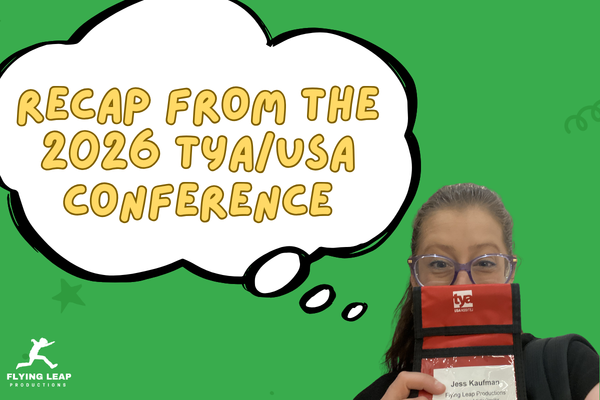
Jess at TYA/USA 2026

Recap from the 2026 TYA/USA Conference

Every year, the TYA/USA Conference is a chance to step outside the day-to-day work of making theater and look at the bigger picture: what's happening across the field, what's shifting, and where our work fits inside all of it. This year, the conference was hosted by the Alliance Theatre in Atlanta, and it was one of the most energizing and clarifying we've attended. Logan joined for the first time, making it the first conference we've attended as a full team!

Here's what we took home.

A Growing Focus on Theater for the Very Young

This year had a notable concentration of programming centered on theater for the very young, or TVY: performances, breakout sessions, and new institutional investment all pointed in the same direction. Part of what made it feel special was the Alliance's Toddler Takeover, a multi-day festival of TVY programming that ran alongside the conference. The Philharmonic set up meet-a-musician sessions for families, TVY shows filled the Alliance's stages and the adjacent museum campus, and the energy was unlike anything we'd seen at a TYA gathering before.

Adding to that, the Alliance and TYA/USA jointly launched a new TVY development fellowship this year, a grant and support program that selected one TVY project from 45 national submissions to develop and present at the festival. Jess served on the grant panel, which meant she got the rare experience of reading a project's proposal and then seeing what it became in performance, with real kids in the room. That full arc, from idea to stage, was exciting to witness.

And it's worth naming what it felt like to be in a space where so much of the work shared our values. For artists who have sometimes felt like outliers in the field, it was genuinely affirming.

Negotiating Risk, and Rethinking Our Pre-Show Speech

One of the breakout sessions Jess attended was led by artist and choreographer Amanda Pintore, whose work centers on dance-based theater made with and for very young children. Amanda's session focused on how we navigate risk in TVY performance: how do we actually give adults permission to step back and let their kids experience a show the way the kid wants to experience it?

Amanda's company uses the phrase "If it's okay with you, it's okay with us" as an invitation at the top of their shows. But as she pointed out, saying it once isn't enough. Permission has to be earned, felt, and held throughout the experience.

That conversation sent Jess straight back to thinking about The Garden, and specifically our pre-show speech. How much of what we say is genuinely opening up space, and how much of it is actually narrowing it? It's a question we're sitting with as we build toward the fall tour.

Amanda also took home an award this year for her production Red, and we were so happy to see her honored.

The Intersection of Theater and Community Health

Another breakout session that stuck with us explored partnerships between arts organizations and health organizations, using the Orlando Family Stage as a case study. The panel laid out something we found both practical and exciting: a theater company and a health organization can serve overlapping communities in complementary ways, and when they work together, each one extends the reach and trust of the other.

The theater's community connects people to cultural programming and arts experiences. The health organization's community connects people to healthcare access and wellness resources. There isn't always overlap between those pools, which is exactly the point. Working together creates access that neither could generate alone.

The session also touched on performing arts medicine, a field that, remarkably, doesn't really exist yet in any formal way. The Orlando partnership began developing a team of specialists who treat performers the way sports medicine doctors treat athletes, attending to vocal health, physical health, and nutritional needs specific to the demands of performance work.

For us, this opened up real questions about The Garden and what community health partnerships might look like alongside our NYCHA programming. The work we're already doing connects families to community spaces and shared experiences. How might we be more intentional about the health and wellness dimensions of that work? We're curious to find out.

What's Happening in the Field

A few broader themes stood out from the week as a whole.

Eco-theater and environmental sustainability are having a moment. The TVY fellowship piece worked with recycled and upcycled materials. And the centerpiece of the weekend was getting to see the final dress rehearsal of Basura, a new musical by Gloria Estefan and her daughter, created in collaboration with TVY playwright Debra Wicks LaPuma. Basura tells the story of the Paraguayan trash orchestra, a real ensemble of children who built instruments from landfill scraps and created something extraordinary. There's a documentary, Landfill Harmonic, if you want to go deeper. The keynote conversation with Gloria Estefan and her daughter to close the conference was warm, honest, and worth every minute.

The other thread running through lunches and coffee conversations all week was sustainability in a different sense: what makes new work financially and structurally sustainable over time, without narrowing what the work can be? Not every show is designed to pack into a trunk and tour to any elementary school in the country, and that's okay. The field is working through what long-term viability can look like for work that resists easy scaling.

We came home with full notebooks, new connections, and a lot to think about. TYA/USA is always an incredible experience, but this year had such a substantial impact we will be thinking about it for months to come. We’re excited to see how what we learned over these last impactful few days changes our approach to the work!

Reflections from the 2026 Spring Flying Leap Retreat

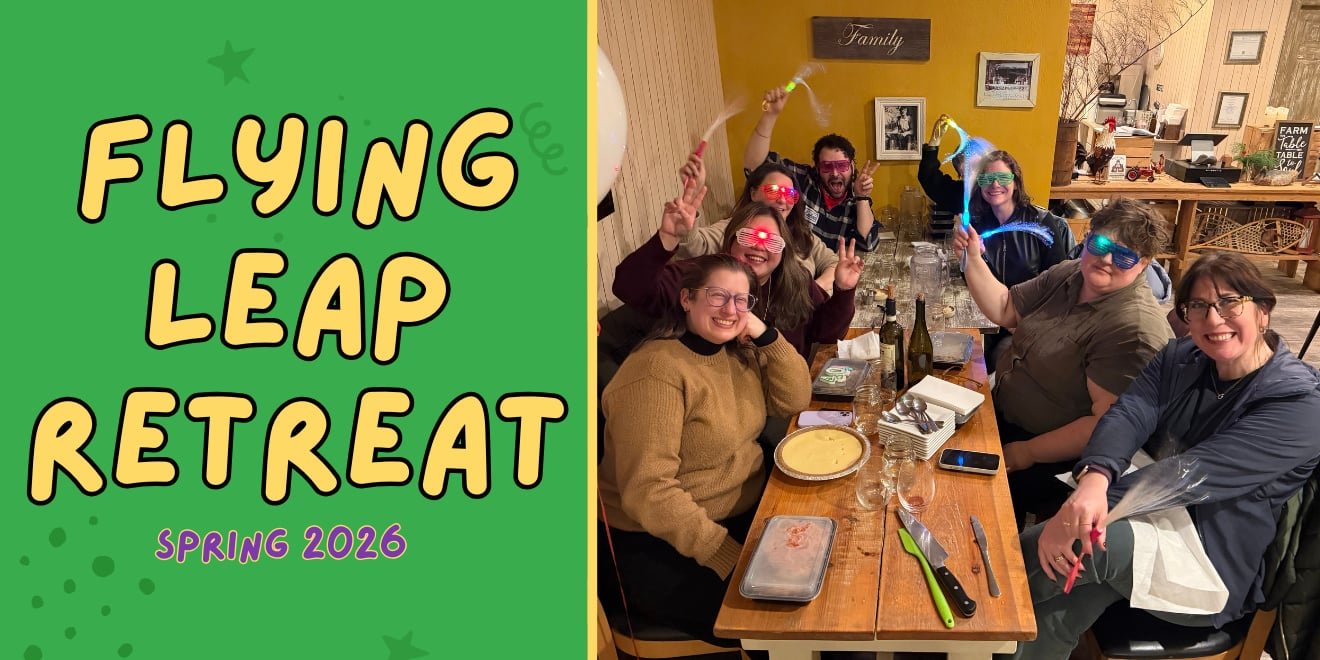
Banner image showcasing flying leap's board at their retreat

Every year, the Flying Leap team steps away from the daily work of making theater to do something harder: think about why we make it, and where we want to go next. This year's retreat brought together our staff and board members for the first time as a 501c3 nonprofit, and what emerged was a weekend we've been carrying with us since.

We asked everyone on the team the same three questions:

  1. What did you take away from the retreat?

  2. What was a moment of care you experienced?

  3. What are you most excited to work on next?

Here's what the team shared.

What We Took Away

Every retreat has its own descriptors. This one felt expansive, grounding, and electric.

Logan gabrielle Schulman was reminded about how unique this company is. "Flying Leap cares so much about our artists and audiences. It's unlike any place I've ever worked."

For Susanna Brock, one of the most energizing moments came during the dreaming sessions: post-it notes on the wall, no idea too big. "During the year we're just in the trenches working on tasks and specific projects, and it's hard to zoom out and think about the big dreams," she reflected. "I always love seeing what dreams come back year to year, and when there are new ideas or projects that come up."

Eve Epstein left with a clearer picture of what board membership at Flying Leap can look like. "Fundraising should be focused on ambassadorship," she said. "We are all connected to the mission. By sharing our enthusiasm, we can direct donors and participants to Jess."

Jess Kaufman was left feeling the weight of the work get lighter. "Now that we have this board, we've gone from a tiny, mighty team of three to something bigger. There are five of us doing admin work for the organization, and we have these three board members, and extra help from Amy Fiore at Nonprofit Help Desk. It was really exciting to dream big in a space where that feels less intimidating, because there are so many brains in the room helping figure out how we get to the next thing."

Carla Zanoni left with a sharper strategic lens. The biggest shift for her: separating the organization-wide pitch from the project-level pitch, and treating them as parallel workstreams rather than nested ones. "We're really good at talking about the projects. The Garden and Beyond the Wall have clear theories of change, clear audiences, clear impact. What we haven't cracked is how to pitch Flying Leap itself." Naming that gap and getting excited to bridge it was the clearest strategic shift to come out of their time together.

Amanda Zamora left inspired and clear-eyed about the challenges ahead. Jess has built, in partnership with the community and her team, an extraordinary model for interactive theater that goes to people and meets them where they are. But the headwinds are real: a culture that rewards scale, speed, and prestige over the kind of slow, care-first work Flying Leap does. "The good news is we have the people and expertise to chart a strategic path forward that is both values-aligned and sustainable in terms of revenue, and the physical and mental resources that Flying Leap's care-first, community-first approach requires."

Moments of Care

Care isn't just a word in our mission statement. It's how we show up for each other, especially when no one's looking. We asked the team to name a specific moment from the retreat that embodied that.

Logan’s moment came in the form of a blizzard and a stuck car. "Jess literally drove out to me in a blizzard to help me push my car uphill through snow and ice. After pushing it a quarter mile up the hill, she called a local tow company, and that's after I had just whooped her in a 6-hour long board game. What a sport!"

Susanna said that care showed up at the table, literally. "We always have such great food. There's always great thought going into the meals, the snacks, and we often get to go out to a restaurant together. All of us are really interested in food, and I think it's really fulfilling to try new things and to experience flavors and textures and talk about them."

It sounds simple. But choosing food with care, making sure people feel nourished and delighted, is its own kind of love language, and it's one Flying Leap speaks fluently.

Eve, who was away from her son for one of her first extended trips, experienced care through being given the space to stay connected. "There was space and time given to call him."

Sometimes care is as simple as that: permission to be a whole person.

Jess’ moment came right at the start. Running her first-ever board meeting, she was nervous, wondering if she'd prepared enough. "These three beautiful, powerful, super smart women walked in the door and immediately started putting out charcuterie and making their own coffee. We got to know each other over cheese and delicious treats, and it just made me feel like, oh, the responsibility is on me to set the tone, but actually everyone is already in the tone together. We all really showed up in a loving, caring way. It made me feel like, yes, we found the right people."

For Carla, care showed up in a moment of collective restraint. Someone raised the logo as needing work, and rather than letting it become a branding rabbit hole, the group named it as "sand, not a rock" and moved on. "Care showed up as permission to say 'that matters, and not right now.' This translated into willingness to offer the feedback, openness to receiving it, and the collective discipline to protect each other's capacity by not chasing every shiny thing."

Amanda found her moment in a pivot. When the group needed to cut workshop time to beat the blizzard home, Jess made the call quickly and warmly, and what followed was a beautiful dinner. Sometimes care looks like knowing when to let go of the plan.

What We're Diving Into Next

This retreat helped us build the runway for what's next. Here's what everyone is launching into:

Logan: "The Garden tour is my biggest project at Flying Leap right now, and I am absolutely stoked to continue confirming venues and partners."

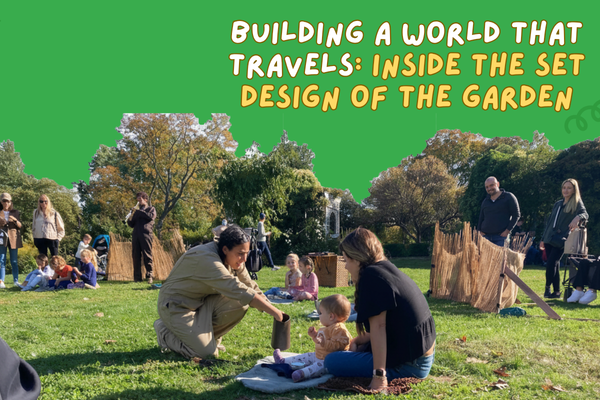
Susanna is deep in design work for The Garden, collaborating with Queens Lighting Collective's Masha Tsimring and Krit Robinson as the world of the show takes on new dimensions. "It's been very exciting to see the Garden world really coming to life and expanding with these new artists we've brought on. And we're about to hire a costume designer, which is very exciting, to really make the world of The Garden more complete and holistic."

Eve Epstein is focused on the long game. "I'm excited to work more on diversified sources of revenue so that Flying Leap becomes sustainable. There is so much opportunity for the organization to grow. This next phase entails clarifying Flying Leap's vision and building an organization that can financially support its staff."

Jess Kaufman is thinking about reach, relationships, and infrastructure. "We spent a lot of time talking about ways to put our work in front of more families and more people who might be interested in what we do. I feel like we're on the cusp of getting to know a lot more people who are excited to get on board with our particular brand of care-driven, queer, loving theater." She's also excited about what's newly possible as a 501(c)(3): "One of the things we talked about is getting a CRM and getting our donation platform up and going. I feel like I know how I can work with everybody to find and say yes to those opportunities, which is really exciting."

Carla Zanoni is focused on audience development as ambassadorship, starting with the person-to-person pipeline that Amy Fiore walked the group through. The gap she wants to close: the in-person experience of Flying Leap is magic, and that magic too often doesn't make it into the rooms where people make decisions about time, attention, or money. Concretely, she's working on building her own ambassador muscle, identifying people in her network who should meet Jess, and thinking about how her professional communities could become a warmer feeder than a cold outreach blast.

Amanda Zamora wants to go deeper with the people who know Flying Leap best. She's excited to conduct stakeholder interviews with community members and families who have experienced Flying Leap's work firsthand, learning what they value most and how invested they are in the organization's future. That knowledge, she believes, is one of the most useful things the board can bring to the work ahead.

What Makes This Team Special

Reading back through everyone's answers, a few things stand out. Care keeps showing up in unexpected places: in a blizzard, over charcuterie, in a phone call home, in a plate of snacks nobody was asked to bring. That's not an accident. It's who we are.

We came to this retreat with big dreams and left with a clearer sense of how to reach them together. We can't wait to show you what comes next.


“The Garden” is Growing: Into New Victory LabWorks 2026!

“The Garden” is Growing: Into New Victory LabWorks 2026!

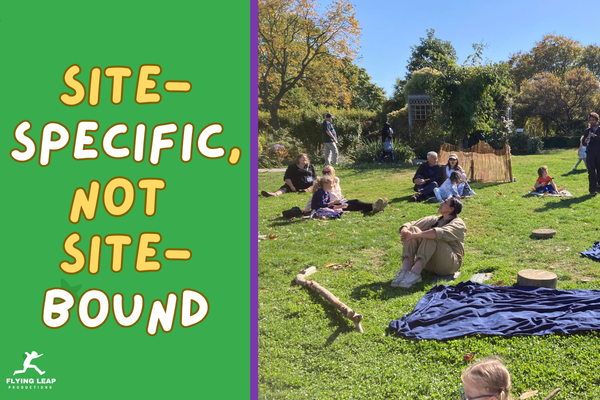
We are absolutely thrilled to announce that The Garden has been selected as the New Victory LabWorks Launch project for 2026! With the support, resources, and community of one of the most respected institutions in theater for young audiences, this dream partnership will take our radically inclusive, site-specific outdoor performance series to the next level – and to NYCHA developments across NYC.

The Production Team Behind Flying Leap's May Day

In celebration of International Workers' Day this year, Flying Leap Productions had the honor of collaborating with SEIU (Service Employees International Union) on a vibrant, community-centered project for May Day Rallies in Chicago and Seattle. Our team was commissioned to lead workshops and build large-scale puppets that would march alongside workers, activists, and community members, bringing artistic expression to these powerful demonstrations of solidarity.

We're thrilled to introduce the remarkable production team who made this collaboration possible, each bringing their own expertise in production, design, and leadership to support this important work.

The Production Team

Adriana Tapia Gomez

Adri Tapia-Gomez, a Mexico City native, is an artist, producer, and dancer based in Seattle, Washington. Throughout 15 years of classical training, she has performed in Miami and the greater Seattle area in productions such as The Nutcracker, La Bayadère, and Les Sylphides, amongst others. In 2021 her training shifted to new styles such as afro dance, jazz, funk, and hip hop. Since then, she has focused mainly on amapiano dance and has traveled to New York, Portland, Dallas, Ghana, and South Africa to further her training in various afro styles. She attended The George Washington University where she obtained her bachelor of arts in political science and French literature, language, and culture.

Adri believes in liberation through arts education in which she encourages people to show up fully and authentically, using dance as a tool for self-expression and connection. She currently works as an artist mentor and teaching artist for Arts Impact and Arts Corps, bringing arts infused learning to schools throughout Washington, as operations manager for Afro Dance Seattle, and as an event producer for a variety of arts organizations within the Seattle area.

Kim Thai

Kim Thai (she/her) is an interdisciplinary mindfulness writer and teacher. As an Emmy-award storyteller and a proud Queer kid of Vietnamese refugees, she has uplifted marginalized voices across different mediums for almost 20 years. Her personal essays on identity, healing and social justice have been published in New York Magazine's The Cut, Newsweek, Buzzfeed and more. She is a certified yoga and meditation teacher and currently a student in Zen Master Thích Nhất Hạnh's Plum Village Buddhist tradition, exploring how we can liberate ourselves from oppressive systems and release embodied trauma through mindfulness. She is currently working on a memoir/mindfulness book on how to reclaim power and joy in the world regardless of what identities you hold. You can follow her work by subscribing to her mindfulness newsletter Just One Breath, where she invites us to see how every moment is an opportunity to transform the world around us.

Corey Janus

Corey Janus is a creative producer, director, and interspiritual minister devoted to the power of story. With a track record in award-winning documentaries, reality TV, digital, and branded content, Corey transforms bold ideas into resonant, high-impact productions. Across every medium, Corey's mission is to spark meaningful connection—through story, play, and soulful expression—igniting deeper truth, curiosity, and human connection.


Headshot of Lucy Wirtz

Lucy Wirtz

Lucy is so excited to get involved with Flying Leap! She is hoping to bring what she has learned through stage managing during her time at UCLA and beyond as well as skills developed working with the Chicago International Puppet Theater Festival and other companies in the Chicagoland area. When she's not working, she enjoys doing improv, cooking, listening to records, and playing mahjong.

With Gratitude

Flying Leap Productions extends our deepest thanks to this extraordinary team of artists whose creativity, skill, and dedication brought our May Day collaboration with SEIU to life. Their contributions not only resulted in towering puppets that captured attention at the rallies, but also facilitated meaningful engagement with union members and the broader community.

The integration of art and activism has long been a powerful force for social change, and we're proud to have worked with this production team who understand the importance of visual storytelling in movements for worker justice. We look forward to future collaborations that continue to bridge art and advocacy, creating work that resonates with communities and supports movements for positive change.